
The landscape is shifting for brands planning to use AI-generated content in their paid and organic campaigns.
If you distribute ads without disclosing that they’re AI-generated, or if you thought people may not detect that your content is AI-generated, pay attention to two recent developments that could impact your plans.
New Legislation Requiring AI Disclosures
Last year, I posted this LinkedIn poll. The results match what I suspected regarding people’s skepticism about AI in ads.

Now, legislation is rolling out June 9 in New York, which passed the AI Transparency in Advertising Act (NY State Senate Bill S.8420-A), which requires any person or entity that creates or produces an advertisement running in New York to clearly and conspicuously disclose if the ad features a “synthetic performer.” This is defined as an AI-generated human or digital replica that looks and acts like a real person but does not actually exist. The penalties include a $1,000 fine for the first violation and $5,000 for each subsequent violation.
Utah also has an Artificial Intelligence Policy Act that requires prominent disclosures if a consumer is interacting with generative AI or if the AI is used deceptively. But New York could be the tipping point. It’s not efficient for brands to run two separate versions of content – one with disclosures for New York and one without for other parts of the U.S.
Furthermore, a wave of bills has been introduced across the country to address AI transparency.
- California: SB 942 (California AI Transparency Act) requires generative AI platforms to embed digital watermarks into AI-generated images, text, and video. More below.
- Illinois: The Digital Voice and Likeness Protection Act targets how brands use digital replicas.
- New Jersey: S4088 (Generative AI Advertising Prohibitions) targets deceptive B2B and B2C marketing.
- Texas: HB149 (Texas Responsible AI Governance Act – TRAIGA) bans the intentional deployment of AI systems used for deceptive trade practices meant to manipulate human behavior or bypass informed consumer decision-making.
AI Detection Tools Are Becoming Ubiquitous
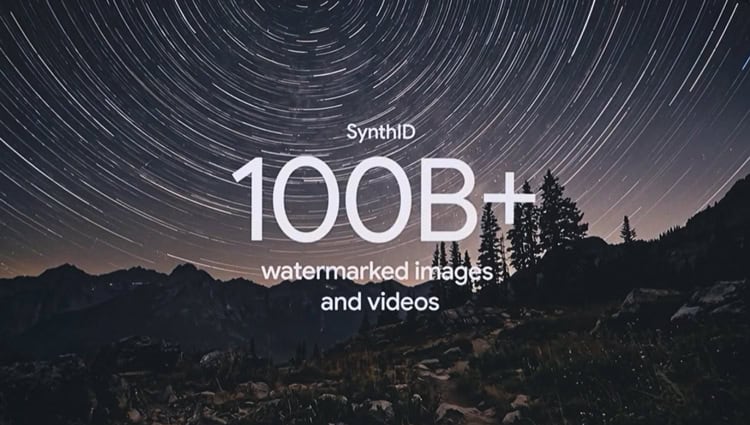
Meanwhile, this week at Google I/O 2026, the company announced it has expanded its SynthID digital watermark initiative as well as content credential verification from the Coalition for Content Provenance and Authenticity (C2PA).
These tools allow users to easily identify AI-generated content, and now they will be available on Google Search and the Chrome browser, as well as Gemini. Also, OpenAI, Kakao, and ElevenLabs will integrate SynthID into their products.
So far, Google has watermarked over 100 billion images and videos and 60,000 years of audio.
Update (May 27): YouTube is rolling out new tools to assist in AI disclosures:
We’re making AI disclosures simpler for creators and clearer for viewers. Here's what's coming:
— Updates From YouTube (@UpdatesFromYT) May 27, 2026
🏷️ Labels for realistic AI-generated content will appear on the video player for both long-form videos and on Shorts.
🔍 We’re introducing automatic AI detection to help creators… pic.twitter.com/2F3pXIvESI
How Tech Companies Should Respond
These new laws and AI detection methods do not mean you should never use AI to create content. Depending on your use case, it could make sense, especially if you’re not featuring human replicas.
But if the main purpose of using AI in content is speed, ask yourself if efficiency is worth the potential of damaging trust. This is an important tradeoff to consider, especially considering recent negative sentiment toward AI.
If you need video support, or you’re struggling on where to start relative to your video strategy, schedule a free consultation with us.